What Your Eavestroughs Are Actually Protecting
Eavestroughs are one of those home systems that operate entirely in the background until they stop working. When they are doing their job, you do not think about them. When they fail, the consequences show up in places that feel entirely unrelated: a damp basement, rotting fascia, eroded garden beds, and in serious cases, foundation damage that is expensive and disruptive to repair. Understanding what a properly functioning eavestrough system actually protects helps explain why the installation and maintenance decisions you make about it deserve more consideration than they typically receive.
Homeowners exploring their options for eavestrough installation services often approach the decision primarily as an aesthetic one, choosing a colour that matches the trim and moving on. The functional decisions are at least as important as the visual ones, and this post covers the main ones worth understanding before installation begins.
The Foundation: The Most Important Thing Eavestroughs Protect
The primary function of an eavestrough system is to collect the water that falls on your roof and carry it away from the building’s perimeter in a controlled way. An average Ontario roof sheds a substantial volume of water during a moderate rainfall event, and without a properly functioning collection and discharge system, that water falls from the eave and saturates the soil immediately adjacent to the foundation.
In clay-heavy Ontario soils, this saturated zone creates the conditions for hydrostatic pressure against foundation walls and basement slabs. Over time, even well-constructed foundations develop cracks and voids through which pressurized water can infiltrate. The eavestrough system that prevents this saturation from occurring is, in a real sense, a first line of basement waterproofing defence, and its failure accelerates the conditions that make more expensive remediation necessary.
Fascia, Soffit, and the Roofline Assembly
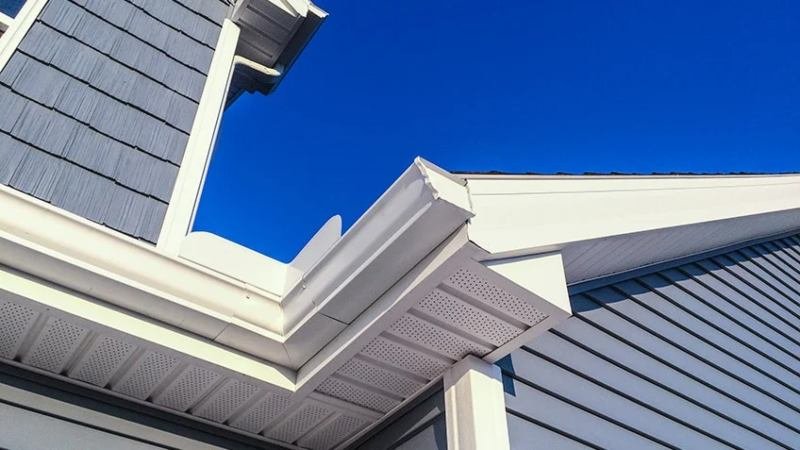
Eavestroughs attach to the fascia board, the horizontal trim board that runs along the lower edge of the roof. When a gutter overflows due to blockage, is improperly pitched, or pulls away from the fascia due to failed hangers or ice load, water runs behind it and saturates the fascia continuously. Wood fascia rots rapidly under these conditions, and what begins as a maintenance issue becomes a structural repair when the fascia fails and must be replaced before a new gutter can be rehung.
The soffit, which covers the underside of the overhang, can also be compromised by water running behind a failing gutter. In homes where the soffit provides the primary ventilation pathway for the attic, persistent moisture infiltration at this point can affect attic ventilation, contribute to condensation and mold issues in the roof assembly, and in serious cases lead to sheathing damage that is not visible from the ground.
Siding and Exterior Cladding
Water that overflows from blocked or improperly pitched gutters repeatedly wets the siding and causes it to deteriorate faster, regardless of the material.Vinyl siding can develop mold and mildew at the joints. Wood siding and trim can soften and rot. Brick and stucco surfaces can develop efflorescence and spalling when repeatedly subjected to the freeze-thaw cycling of saturated masonry in Ontario winters.
These are not inevitable consequences of age. Water management failures at the roofline accelerate these problems.A functioning eavestrough system keeps the wall assembly behind it significantly drier than it would otherwise be, and the longevity of the exterior cladding reflects that protection over years and decades.
Downspout Placement and Discharge Location
The eavestrough collects the water. The downspout discharges it. Where that discharge happens matters enormously. A downspout that terminates at the foundation wall, or within a metre of it, is routing the roof’s water load directly to the most vulnerable point of the building envelope. Extensions that carry the discharge at least two metres from the foundation, or underground connections to a storm drain or dry well, are standard practice for good reason.
Properties with slopes that direct water toward the house, or sites where previous construction has disturbed the soil near the foundation, require especially careful planning for downspout discharge locations.An installer who simply locates downspouts at the most convenient structural points without considering where the water goes afterward is designing a collection system without completing the design of the discharge system.
Seamless vs. Sectional: The Installation Choice That Affects Long-Term Performance
Sectional gutters, assembled from pre-cut lengths joined at seams, have joints at every connection point. In Ontario’s climate, these joints are the most vulnerable part of the system. Sealant degrades under UV exposure and thermal cycling, and the seams that were watertight on installation day develop small separations over time that allow water to drip behind the fascia rather than travel to the downspout.
Contractors fabricate seamless gutters on-site to match the exact dimensions of each run, placing joints only at corners and downspout connections.The reduction in seam count directly reduces the number of potential failure points and the maintenance attention those points require over the system’s life. For most homeowners in Ontario planning a new installation, seamless systems represent a better long-term investment for a modest premium over sectional alternatives.