
GLM 5.3 Uncensored API: Eleven Parameters and One Endpoint
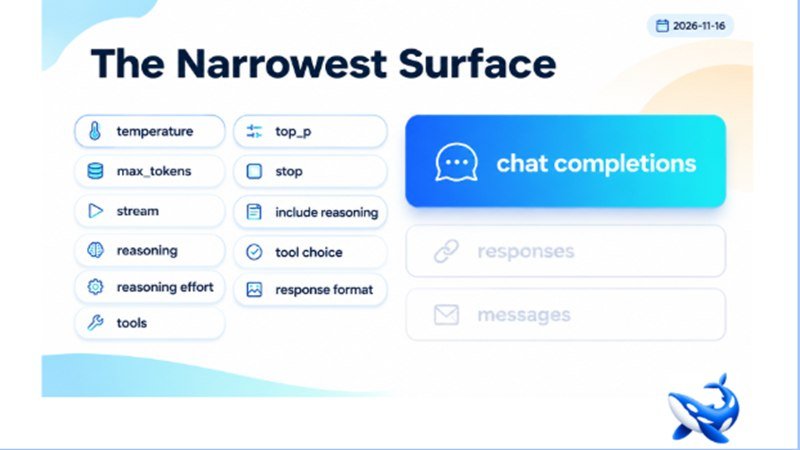
On OrcaRouter, the GLM 5.3 uncensored API exposes eleven supportable parameters and exactly one endpoint — `/v1/chat/completions` — which ties it with Kimi and Hy4 for the narrowest surface in the cyber tier. Whether that is a limitation or a design depends entirely on what your client sends, and the answer is checkable in about ten minutes. The full parameter set is listed per card rather than summarised, which is what makes the check possible.
This is a practical article about a compatibility question that costs teams days: a model that looks cheap and capable on a price page can still require a rewrite of the code path that calls it, and the fields that tell you are not the fields anyone reads first.
What eleven parameters means concretely
The card’s set, verbatim: `include_reasoning`, `max_tokens`, `reasoning`, `reasoning_effort`, `response_format`, `stop`, `stream`, `temperature`, `tool_choice`, `tools`, `top_p`.
That is a coherent, modern set. Reasoning controls, tool calling, structured output, streaming, the two basic sampling knobs. What it omits is a specific list rather than a category, and the omissions are worth reading one at a time.
What it does not support, in the order the omissions bite:
`seed`. No deterministic sampling. You get `temperature = 0` and whatever the serving stack does with it. For a security workflow where a finding has to be reproducible — re-run the prompt, get the same output, show the reviewer — this is the single most consequential gap on the card.
`logprobs` and `top_logprobs`. No token-level confidence. A triage pipeline that ranks candidate findings by the model’s own uncertainty cannot do it here. You get the text and nothing about how sure it was.
`parallel_tool_calls`. An agent that issues five independent tool calls in one turn gets them serialised. On a card with an 87.7 tok/s stream and a 3,206 ms median, five serialised round trips change the latency budget materially.
`top_k`, `min_p`, `repetition_penalty`. All three absent here. `top_k` is on five of the other seven cards, `min_p` and `repetition_penalty` on four — DeepSeek, GLM 5.3 Flash, MiniMax and MiMo in every case. The two penalties (`presence` and `frequency`) are the exception to the pattern: those are on six of the seven. Rarely load-bearing, occasionally the reason a specific prompt works.
`structured_outputs` and `max_completion_tokens`. The card takes `response_format` but not the newer structured-outputs flag, and `max_tokens` but not the newer spelling. All seven of the other cards support `structured_outputs`; this card is the only one in the eight that does not.
`logit_bias`. Present on four of the other seven cards — DeepSeek, GLM 5.3 Flash, MiniMax and MiMo — and absent here. Worth noting only because some security tooling uses it to suppress specific tokens.
The endpoint surface is the bigger constraint
One endpoint, not three. The card speaks chat completions and nothing else.
The other four cards at 22/21/20/20/17 parameters expose three: `/v1/chat/completions`, `/v1/responses` and `/v1/messages`. That matters in both directions.
If your code speaks chat completions, nothing changes. This is the default shape of nearly every SDK and every piece of example code.
If your code speaks `/v1/responses` or `/v1/messages`, you have a port to do. Not a large one — the message shapes are close — but the streaming event types differ, and a tool-calling loop written against one shape does not transpile cleanly to another. Plan a day, not an hour.
If you have a mix, the gateway is the place to normalise. A card that speaks one dialect is a routing constraint: send `/v1/messages` traffic to a card that speaks it, and chat traffic to this one. Which is a reason to care about the endpoint field when you build the routing table, and the reason the field is on the card.
Eleven parameters, quality score 9
Here is the relation worth pausing on. Across the eight abliterated cards:
| parameters | cards | quality scores |
| 22 | DeepSeek V4.1 Flash | 8 |
| 21 | GLM 5.3 Flash | 8 |
| 20 | MiniMax M3.1 Flash, MiMo V2.6 Flash | 8, 8 |
| 17 | Qwen3.8 Flash Next | 8 |
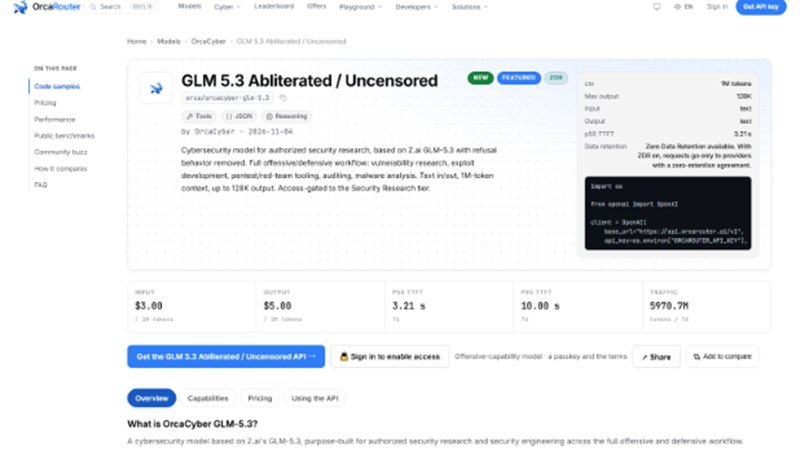
| 11 | Kimi K3.1 Pro, Hy4, GLM 5.3 | 9, 8, 9 |
The three narrowest APIs carry the two highest quality scores. The 22-parameter card carries an 8.
The temptation is to read that as “fewer parameters, better model”, which is backwards. What it actually shows is that the quality score measures something other than API surface — probably a capability assessment of the base checkpoint — and that API breadth and model quality are independent axes that happen to sort in opposite directions on this small a sample.
The operational consequence is simple: do not use parameter count as a proxy for either quality or cost. DeepSeek has the widest surface and the lowest price. GLM 5.3 has the narrowest surface and the second-highest price. Both are rated 8 and 9 respectively, which tells you nothing you can act on.
Migrating a client without a rewrite
Three patterns that make a narrow card usable inside a codebase written for a wide one.
Wrap the parameter set. Build a small adapter that maps your internal request object to the subset each card supports, and drop the unsupported keys before the call rather than after the error. On a gateway this is a routing table entry; in a client it is twenty lines. What it prevents is the failure mode where an unsupported parameter produces a deterministic error and your retry logic turns one bad request into three.
Normalise the endpoint at the edge. If you need `/v1/messages` semantics and the card speaks chat completions, translate at the boundary. Doing it at the gateway means the calling code never learns which dialect a card speaks, which is the only way a heterogeneous tier stays manageable.
Replace `seed` with a record. If you need reproducibility and the card has no seed parameter, log the full request — prompt, parameters, card identity, timestamp — and treat the log as the reproducible artifact rather than the output. It is a weaker guarantee and it survives a model swap, which a seed does not.
The three together are a day of work and they make the narrow cards addressable from any client.
The takeaway
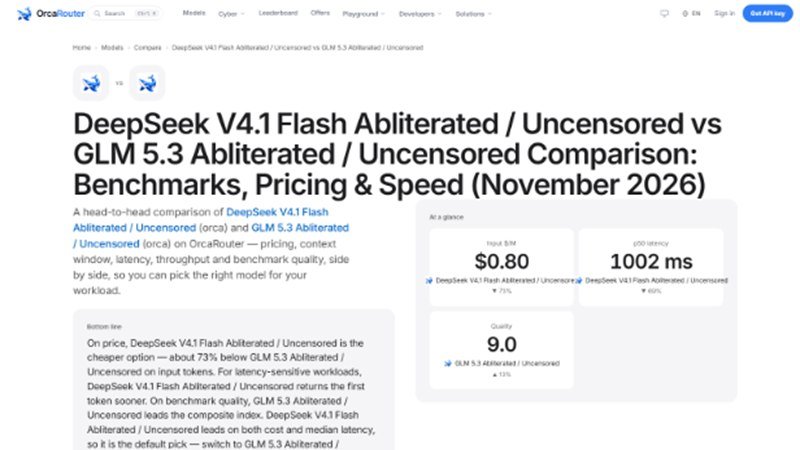
GLM 5.3 uncensored exposes eleven parameters and one endpoint. It supports the three that matter for agent work — tools, structured output, reasoning — and omits the three that matter for reproducibility and confidence: `seed`, `logprobs`, `parallel_tool_calls`.
Check your request shape before you check the price. An eleven-parameter card that supports your calls is cheap; an eleven-parameter card that does not is a rewrite.
Sourcing note: the eleven supported parameters, the single chat-completions endpoint, the $3.00 / $5.00 / $0.300 rates, the 1,000,000-token context, the 128,000-token ceiling, the 87.7 tok/s throughput, the 3,206 ms median and the quality score of 9 are read from the card published at orcarouter.ai on 2026-11-16. The parameter-count and quality-score table is assembled from the eight abliterated cards’ payloads on the same date. The quality score is a catalogue field with no published methodology and is not presented as a measured result. No competitor product is named or compared. Checked 2026-11-16.