How to Build a Lifelong Birthday Keepsake for Your Child
There’s a particular kind of magic to a child’s birthday. The cake, the candles, the way they look at you when everyone sings. But somewhere between the wrapping paper and the leftover frosting, the details start to slip away. Who came to the party. What gift they couldn’t stop hugging. The exact way they answered when you asked what they wanted to be when they grew up. By the time a child turns ten, the early years tend to blur into a single warm memory, and the small specifics that made each year unique are mostly gone.
The good news is that capturing it doesn’t require a scrapbooking habit or hours of effort. It just requires a place to put the moments, and the discipline to spend about thirty minutes once a year.
Start Before the First Birthday
The birthday story doesn’t really begin on the day a child is born. It begins months earlier, with the first ultrasound, the first heartbeat, the first time their face appeared on a screen. Those early prenatal images are some of the most meaningful pieces of a child’s story, and they deserve a permanent home rather than a faded thermal print stuck in a drawer.
If you’re still in the pregnancy stage, consider booking an elective 3D or HD ultrasound session at a prenatal imaging center between twenty-six and thirty-two weeks. This is the window when baby’s facial features are most defined, and the images you get will become the opening pages of a lifelong keepsake. Save them alongside the birth announcement, the hospital bracelet, the first family portrait, and a written copy of the birth story. Together, these form the prologue to every birthday that follows.
The First Birthday
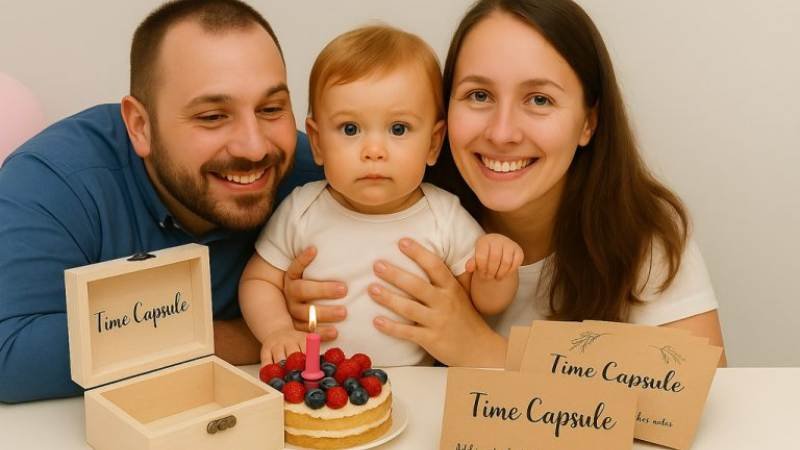
A first birthday is mostly for the parents. The baby won’t remember it, but you will, and one day they’ll want to see what it looked like. Take photos of the baby in their first-birthday outfit, the cake you chose, and the people who came to celebrate. Write down what you served, how the baby reacted to candles, and one funny moment from the day.
Then write a letter. It doesn’t have to be long. A paragraph about who they are at one year old. What makes them laugh. What words they say. What they look like when they’re concentrating. This is the practice that makes every birthday after it meaningful, because you’ll start to see how much changes year over year.
Years Two Through Five: The Personality Years
These are the years a child becomes a person. Each birthday captures a completely different human than the year before. At two, they’re discovering language. At three, they’re full of opinions. At four, they’re inventing whole imaginary worlds. At five, they’re starting to understand how the world fits together.
For each birthday, capture three things: a photo from the day, a few sentences about how you celebrated, and a letter to your child. The letter is the part that matters most. Include their favorite foods, their best friends, the games they love, the things that scare them, the way they say certain words. Write down the questions they ask. These are the details no photograph can hold.
A prompted keepsake book makes this easier because the prompts are already written for you. The format that tends to work best gives you two pages per birthday: one for the photo and celebration details, one for the letter. It takes about thirty minutes a year, which is exactly the kind of commitment a busy parent can actually keep.
Years Six Through Twelve: The In-Between Years
These are the years that disappear fastest in memory because they all start to feel the same from the outside. School pictures, sports practice, lost teeth, family vacations. But every year a child is becoming someone new, and the changes between six and twelve are some of the most dramatic of their entire life. Capture them.
A photo from each birthday. Who their best friend was that year. What they wanted to be when they grew up. The book they were reading. The song they couldn’t stop singing. Write a letter that tells them what you noticed about them that year. What you’re proud of. What you’re watching them grow into.
The Teenage Years
This is where most parents stop documenting, which is exactly when they shouldn’t. The teenage years pass fast and feel turbulent, and a child who reads their parent’s words years later about who they were at fifteen often finds it one of the most meaningful gifts they’ve ever received. Keep writing the letter, even if you only get a few sentences. Include a photo. Note the year, the friends, the firsts. By eighteen, your child will hold a complete record of their own becoming.
A Few Practical Tips
A keepsake only works if it’s something you’ll actually maintain. Pick one place and use only that place. Loose photos and scattered notes always get lost. Do it the same week every year, ideally the week of the birthday itself, while details are fresh. Use a flat-lay book that opens fully on a table, because the frustration of fighting a stiff spine is enough to make most parents quit by year three. Keep a pocket or envelope for loose items like birthday cards, ticket stubs, or a drawing they made for you that year. And don’t try to make it perfect. The point isn’t a museum-quality scrapbook. The point is a record of attention.
A Gift They’ll Open Twice
The first time your child opens their birthday book, they’ll flip through it as a curiosity. The second time, often years later, often when they have children of their own, they’ll read it slowly. They’ll see how you saw them. They’ll know they were paid attention to. That’s the real gift. The book is just where it lives.